Pantry notebook 006 · November 3, 2026
How to add freeze-dried vegetables to rice
Protect the rice method first. Prepare one labeled vegetable portion separately, measure what it becomes, then decide whether a one-pot version has enough documented water and time.
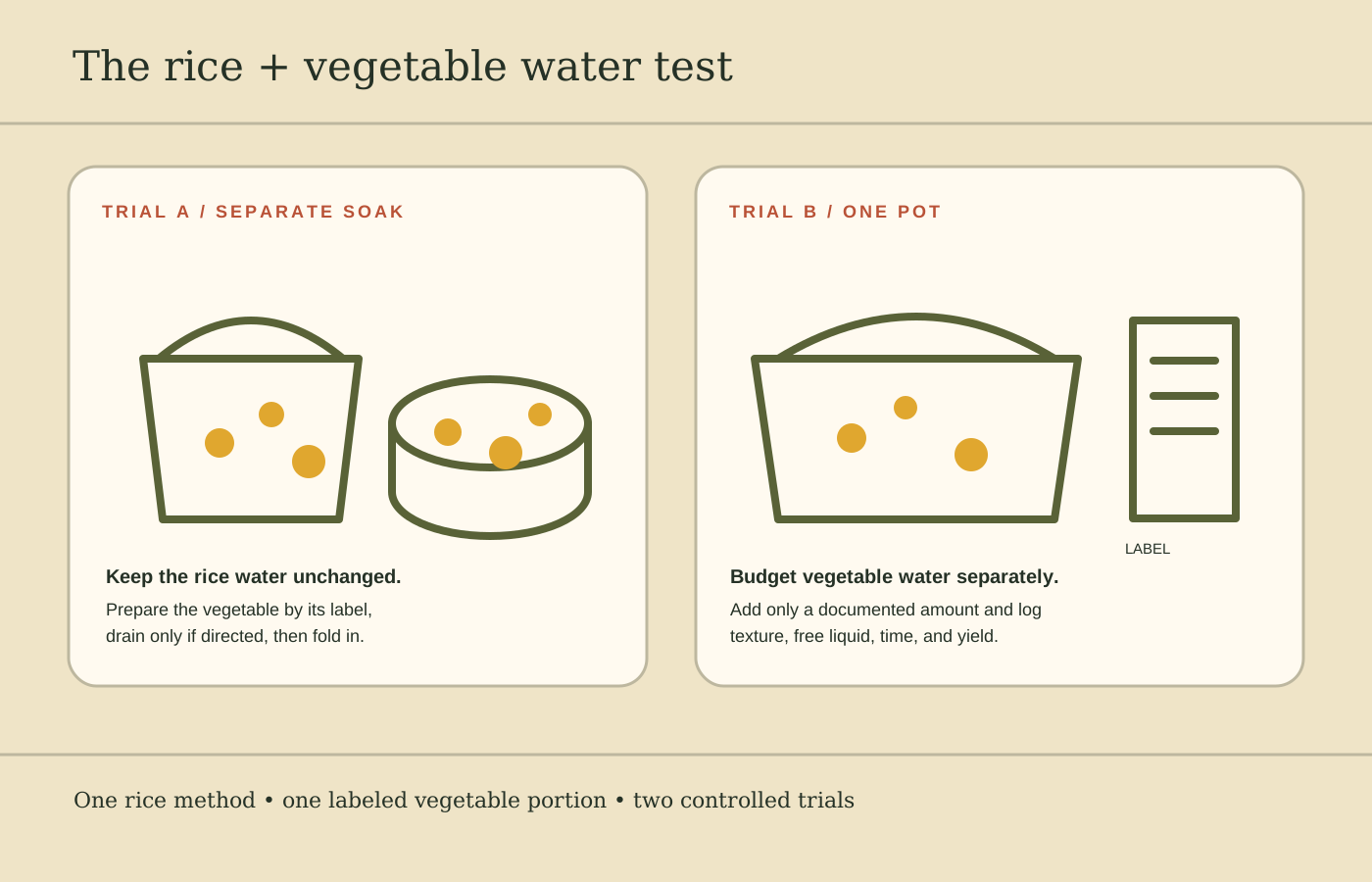
Rice and freeze-dried vegetables both depend on water, but they do not share a universal water budget. Pouring an extra scoop into the pot can leave the grain broken and wet; adding no extra water can leave the vegetables leathery and the rice underdone. The useful answer begins with two separate labels.
One label defines how a particular rice is cooked. The other defines how a particular freeze-dried vegetable is prepared. Species, cut size, processing, seasoning, fines, and whether the vegetable is intended as a crunchy ready-to-eat snack or a rehydrated ingredient all change the result. The words “freeze-dried vegetables” do not supply a ratio.
This guide uses a small two-trial method. Trial A prepares the vegetable separately while leaving the rice instructions untouched. Trial B attempts a one-pot version only after Trial A has produced a measured portion, texture note, and water record. That sequence answers a high-intent kitchen question without turning one product’s result into a rule for every pouch.
The 2026 FDA Food Code added § 3-501.10, stating that commercially packaged dehydrated food with manufacturer rehydration information should be rehydrated according to those instructions. The Food Code governs retail and food service as a model for jurisdictions, but its label-first principle is equally practical at home. Follow the exact package for preparation, cooking status, allergens, storage, and use after opening.
Read both methods before opening either package
Copy the instructions rather than relying on memory. Rice packages can differ by grain, milling, precooking, pot, appliance, altitude note, and resting step. Freeze-dried vegetable directions can differ by water temperature, amount, soaking time, simmering requirement, and whether excess water is drained.
| Field | Rice package | Vegetable package |
|---|---|---|
| Measured dry amount | Rice portion used in the test | One labeled serving or a weighed test portion |
| Water | Exact amount for that rice portion | Exact amount or coverage instruction for that vegetable |
| Heat | Boil, simmer, cooker setting, or other method | Cold, warm, hot, boiling, simmering, or no heat |
| Time | Cook time plus covered rest | Soak, stir, simmer, or cooking time |
| Finish | Fluff, rest, drain, or hold | Drain, retain liquid, cook further, or use directly |
| Storage | Dry package and cooked-rice directions | Unopened, opened-dry, and prepared-food directions |
Do not combine products merely because their stated times overlap. A vegetable that needs ten minutes in hot water may hydrate in a covered bowl but remain firm in a rice cooker whose heat cycle and free-water level change continuously. A rice method that relies on absorption can be disrupted by vegetable pieces taking water at the same time.
Confirm what the vegetable actually is
Read the statement of identity and ingredient list. A single-ingredient pea, corn, carrot, bell pepper, broccoli, zucchini, or mixed vegetable has a different job from a seasoned blend, soup base, or complete meal. Salt, starch, oil, dairy, sugar, broth powder, or a carrier can change both liquid behavior and seasoning.
Also confirm whether the product is ready to eat. Freeze-drying is not a synonym for a kill step. Utah State University Extension notes that microorganisms can survive freeze-drying and become active again after rehydration. A commercially packaged product’s current preparation and cooking directions control; do not copy handling advice from a different pouch.
Trial A: keep the rice method unchanged
The separate-soak control creates a dependable baseline. It isolates vegetable water from rice water, makes texture easy to inspect, and prevents a one-pot failure from hiding which ingredient caused it.
- Choose a small normal batch. Use the rice amount you often cook, not a special oversized test. Record the pot or appliance because geometry and heat matter.
- Weigh one vegetable portion. Record product, lot, cut, dry grams, and visible fines. A cup of irregular pieces is harder to repeat than a gram weight.
- Prepare the vegetable exactly as labeled. Measure water and temperature. Record start time, stir step, soak or simmer time, and whether directions say to drain.
- Cook the rice by its own package. Do not reduce or increase its water to compensate for a separately prepared vegetable.
- Measure the prepared vegetable. Record drained or undrained weight and volume as appropriate. Keep the method visible so those figures are not mistaken for a universal yield.
- Combine at the least disruptive point. Fold tender prepared vegetables into rested rice, or add them at the package-directed stage if further cooking is required. Avoid aggressive stirring that breaks the grain.
- Score the result. Note rice doneness, free liquid, vegetable core texture, flavor concentration, distribution, and total prepared yield.
Manufacturer examples show why the label matters. Augason Farms tells readers to follow each product for water quantity, temperature, soaking time, and cooking time, while noting that many dry vegetables may go directly into dishes only when the recipe provides enough liquid and cooking time. That guidance does not prove a rice-pot ratio for a particular vegetable, so the exact pouch and Trial A still control.
Trial B: build a water budget, not a guess
Attempt a one-pot version only if the vegetable package supports direct cooking or the maker’s preparation can be integrated without skipping a required step. Keep the same rice, pot, batch size, and heat method from Trial A.
Trial A gives you three useful observations: how much labeled water was introduced, whether any was drained or remained free, and what texture the vegetable reached. That information frames a conservative one-pot test, but it does not automatically tell you to pour all vegetable water into the rice. The vegetable may not absorb every gram, while the rice pot may lose water differently than a covered bowl.
Keep the rice package amount as the anchor. Document any added liquid as a separate test variable. If no manufacturer information supports direct addition, use the separate method instead. If you test, begin with one vegetable portion rather than doubling the entire meal, and change only one variable per batch.
- Record the hypothesis. State the exact vegetable amount, added water, and addition time before cooking.
- Reserve adjustment water. Do not dump in an unmeasured “extra splash.” Measure a small reserve so any addition can be logged.
- Place ingredients deliberately. Small pieces distribute differently from flakes or powder. Keep them below the lid and away from vents or exposed heating surfaces.
- Respect the rice method. Do not repeatedly open a covered pot, stir an absorption rice, or interrupt an appliance cycle unless its instructions allow it.
- Rest before judging. Complete the rice package’s rest step; moisture continues moving through the grain and vegetables.
- Compare with Trial A. Use the same fields: rice doneness, free liquid, vegetable texture, flavor, distribution, and yield.
A failed trial is useful when it changes the next decision. Wet rice with fully tender vegetables suggests too much free liquid or an addition that released water late. Dry rice with a firm vegetable core suggests competition for liquid or insufficient contact time. Tender rice with faded, fragmented vegetables suggests the cut entered too early. Do not “fix” all three variables at once.
Choose the vegetable’s timing lane
Fold in after the rest
Best starting point for separately prepared tender vegetables when the rice is already correct. Drain only if the vegetable package directs it.
Add for the covered rest
Useful only when the product is ready to eat or fully prepared and needs brief warming rather than cooking. Avoid cooling the rice with excess cold liquid.
Join during cooking
Use when the manufacturer supports direct addition and the documented water and time fit the rice method. Record the exact stage.
Cook separately
Choose this for uncertain instructions, mixed cut sizes, required simmering, specialty rice, or a first trial where texture matters.
Piece size often matters as much as vegetable type. Fine bell pepper or herb fragments hydrate quickly and distribute widely. Dense corn kernels, peas, carrot dice, broccoli stems, or thick zucchini may need more contact time. Mixed vegetables can finish unevenly because the smallest piece sets the seasoning while the densest piece sets the texture deadline.
Season after the water test
Salt, broth concentrate, sauces, and acidic ingredients can change flavor perception and sometimes the cooking behavior of a dish. Keep Trial A simple. Once water and timing are repeatable, add seasoning in a measured layer. Check the vegetable ingredient list and Nutrition Facts first so a seasoned blend is not salted twice.
Turn one test into a pantry card
A pantry card prevents the next meal from returning to guesswork. Keep the result tied to one product and lot, and revise it when the label changes.
Rice + vegetable test card
Record these nine fields
- Rice name, dry amount, and method
- Rice package water and rest
- Vegetable name, lot, cut, and dry grams
- Vegetable label water, temperature, and time
- Separate or one-pot trial
- Exact addition stage
- Prepared vegetable yield
- Rice and vegetable texture result
- Leftover cooling and use date
Do not publish a home test as a shelf-life statement, safety validation, or manufacturer yield. It is a kitchen note for a defined product, amount, method, and batch. The strongest product listing would show the current label, ingredients, allergens, net weight, dry serving, preparation directions, prepared yield when the maker states it, storage language, and cooking status.
After cooking, manage the dish as leftovers
Dry rice and sealed freeze-dried vegetables may be shelf stable under their package conditions. The finished vegetable rice is prepared food. Put perishable leftovers into shallow containers and refrigerate within two hours—one hour when ambient temperature is above 90°F—unless a product instruction is more restrictive.
USDA advises using most cooked leftovers within three to four days and reheating leftovers to 165°F. Reheat only the portion needed and add moisture deliberately if the rice has dried. A later reheat cannot make a dish safe when it spent too long at room temperature; some toxins can persist even after high heat.
Date the container with the cook date and planned use date. Do not leave the rice in a warm cooker, on a buffet, or in a deep pot while deciding. If the package requires a shorter time or a different handling route, follow it.
A purchasing note for this preview pantry
Freeze Dried Savory publishes education and unbranded pantry briefs. Checkout, prices, inventory, branded listings, availability, reseller claims, and supplier claims remain disabled until authorization and accurate commercial terms are documented. A vegetable listing is not useful without the exact cut, ingredients, allergens, net weight, serving basis, preparation method, cooking status, storage directions, and manufacturer-stated yield.
Sources
Reviewed November 3, 2026. Product-specific manufacturer instructions remain controlling.
- U.S. Food and Drug Administration — Food Code 2026
- FDA — Summary of Changes in the 2026 Food Code
- Utah State University Extension — Can I Freeze-Dry That?
- Augason Farms — How to Rehydrate Freeze-Dried Foods
- Augason Farms — Freeze-Dried Fruits and Vegetables Preparation Guidance
- USDA FSIS — How do I handle leftovers safely?
- USDA FSIS — What methods of reheating food are safe?