Pantry notebook 003 · October 15, 2026
How to rehydrate freeze-dried vegetables safely
The shelf-stable stage ends when the preparation begins. Copy the exact package directions, measure the water, separate rehydration from cooking, and start a new time-and-temperature plan for the prepared food.
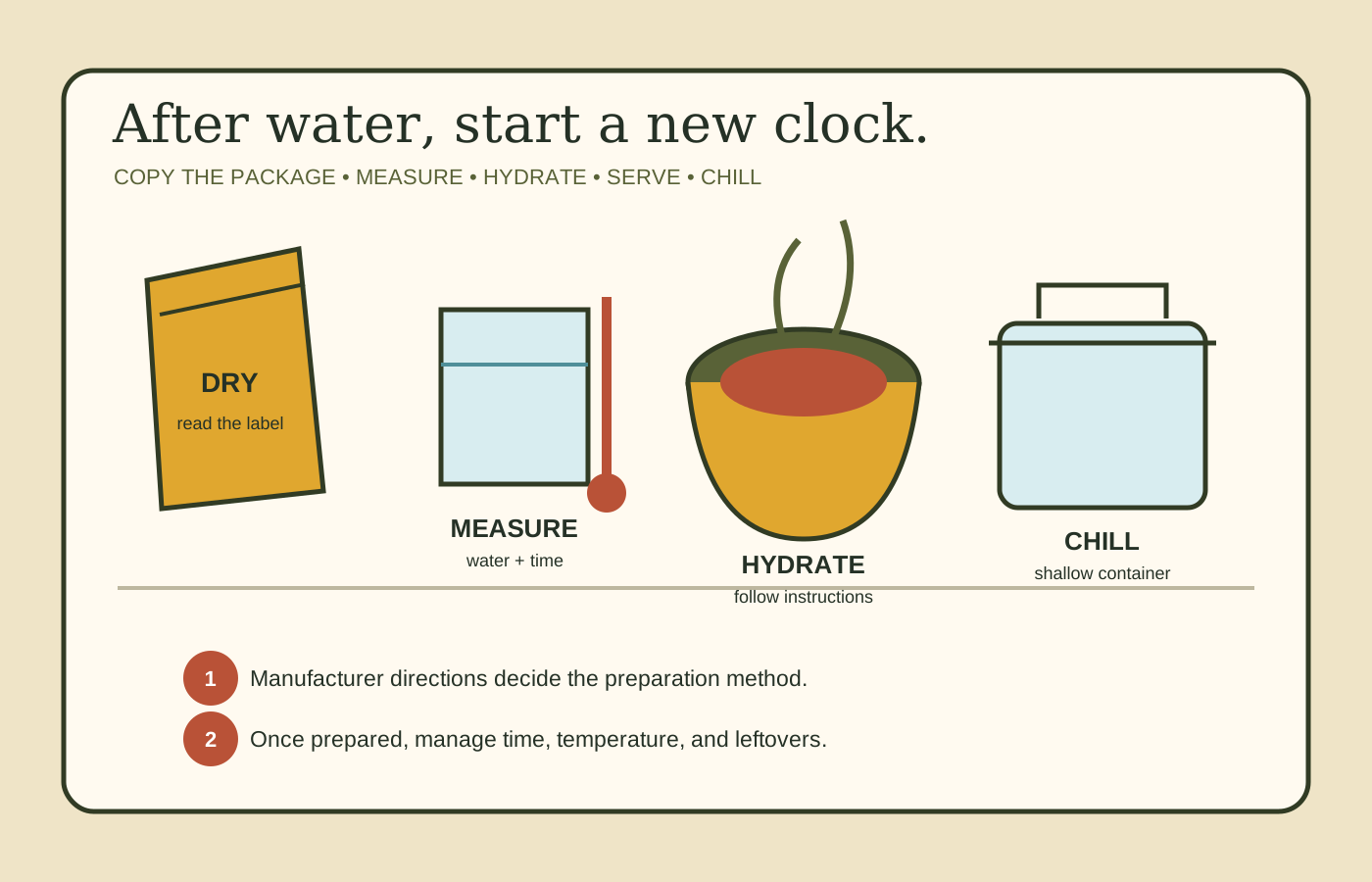
A sealed pouch can be easy to store and still require careful preparation. The moment water is added, the useful questions change. Dry net weight no longer tells you the prepared amount. A rest time does not automatically satisfy a cooking instruction. A bowl that will not be eaten now needs a cooling and refrigeration plan.
That handoff is easy to miss because public discussions often collapse four separate questions into one: “How much water do I add?” Readers also ask whether vegetables can soak in cold water, whether the liquid should be drained, when seasonings belong, and how long a hydrated batch keeps. Those questions do not have one category-wide answer. Freeze-dried peas, mushroom slices, onion powder, seasoned vegetable blends, and complete meals can carry different directions and risks.
A timely federal update makes the label-first approach unusually clear. The newly released 2026 FDA Food Code adds section 3-501.10 for commercially packaged dehydrated food. Its central instruction for retail food establishments is to prepare that food according to the manufacturer's instructions. The Food Code is a model for retail and food-service regulation, not a household cookbook or a promise about every pouch. Still, its new section captures the right consumer habit: do not replace product-specific directions with a generic internet ratio.
The current package or manufacturer documentation controls product-specific water, rest time, cooking, serving, and storage. Public food-safety guidance helps manage prepared food after water and other ingredients have been added. Use the more restrictive instruction when they differ, and contact the manufacturer when the label is incomplete.
Copy six lines before opening the pouch
A photo of the front panel is not enough. Turn the package over and make a short preparation card. This keeps serving-size arithmetic, water directions, cooking status, and after-opening storage from blending together.
| Copy this | Why it matters | Do not substitute |
|---|---|---|
| Exact product and lot | Ties the test to one formulation and package | A different cut, flavor, or older label |
| Dry amount used | Makes the result repeatable | An unverified “handful” conversion |
| Water amount and temperature | Controls absorption and prepared yield | A category-wide ratio from another brand |
| Rest, simmer, or cook time | Separates soaking from required cooking | Texture alone as a safety test |
| Drain or retain liquid | Affects flavor, sodium, nutrients, and recipe volume | Assuming all soak water belongs in the dish |
| Storage after opening or preparation | Starts the correct storage plan | Extending the unopened shelf-life claim |
The words matter. “Rehydrate,” “simmer,” “cook thoroughly,” “ready to eat,” and “add directly to recipe” are not interchangeable. A package might describe several methods for different uses. Choose the method that matches the dish, then follow it completely. If the manufacturer posts updated directions, verify that they match the exact product name and size in hand.
The ingredient list also changes the plan. Plain vegetables may be used as components, while a seasoned blend can contain salt, dairy, soy, wheat, sesame, or other allergens. FDA-regulated packaged foods must identify major allergens as required, but the actual current label is the source for the product. Cross-contact concerns and household dietary limits cannot be answered by the phrase “freeze-dried vegetables.”
Do the yield math in the right direction
Prepared yield should come from a maker statement or a measured kitchen test for the exact product. Dry volume is light and full of air spaces; it does not convert cleanly to hydrated cups across cuts. If the package says one dry serving prepares a stated amount, multiply by the number of labeled servings used. If it gives only water directions, record the measured finished amount after preparation instead of inventing a claim.
Keep “water added” and “prepared yield” in separate columns. Some water remains free in a soup; some is absorbed; some may be drained. Those outcomes are all different from the amount poured into the bowl.
Run a five-stage rehydration clock
- Inspect the package. Check the seal, damage, lot identity, and applicable date or storage statement. Do not taste food from a swollen, leaking, wet, or otherwise compromised package.
- Prepare clean tools and safe water. Wash hands and use a clean vessel, measuring tool, utensil, and lid. Use water that is safe to drink. Keep the dry scoop out of steam and moisture.
- Measure, then follow the stated method. Use the manufacturer's water temperature, amount, time, and cooking instruction. Start the timer when the directions say to start it. Stir only when directed or when needed for even wetting.
- Evaluate the intended use. Confirm whether the product is now ready for the dish or still needs cooking. Add it to the recipe at the stage supported by its directions.
- Serve or start the storage clock. Eat the prepared amount promptly, keep it at a safe hot or cold temperature when applicable, or move leftovers into a prompt cooling and refrigeration plan.
This clock prevents a common mistake: leaving a covered bowl on the counter because it began as shelf-stable food. Adding water removes the dry-state assumption. The final dish may also contain cooked grains, broth, meat, dairy, eggs, or other ingredients with their own handling requirements.
Batch note
Record eight facts, not an impression
- Product and lot
- Dry grams or labeled measure
- Water amount and temperature
- Rest or cook time
- Drained or retained liquid
- Finished volume or weight
- Time preparation finished
- Storage or serving action
Protect texture without rewriting the safety directions
Texture is a useful quality observation, but it cannot prove that a required cooking step was completed safely. Solve texture inside the package method. If the directions allow direct addition to soup, give dense pieces enough time before adding quick-hydrating herbs. If they call for a covered rest, keep the vessel covered for that period. If they specify draining, taste the ingredient only after the stated preparation is complete.
For a component served on its own
Start with the precise labeled ratio and time. At the end, check the center of the largest pieces. Record firmness, free liquid, and final weight or volume. Change only one quality variable in the next batch—water, time, or cut size—without dropping a required cooking step. Small changes are easier to interpret than a new ratio, temperature, and method all at once.
For soup, sauce, or a grain bowl
Count all liquid in the recipe. Water released by fresh vegetables and liquid absorbed by rice, pasta, beans, or freeze-dried components all affect the finished pot. Hold back concentrated seasoning until hydration is nearly complete; water adjustment is easier before sodium and spices are fully committed. The freeze-dried soup builder provides a separate staging method for water, texture, and sodium.
For powders and small aromatics
Powders can clump when dumped into hot liquid and can intensify quickly because they disperse throughout a dish. Whisk into a measured portion of liquid when the label supports it, then add that slurry to the larger recipe. Fine aromatics may need less time than large pieces. Again, use the product direction rather than transferring a method from a visually similar ingredient.
If a trial fails, do not overwrite the label in your pantry notes. Keep the maker direction intact and write the kitchen observation beside it: “largest pieces still firm after stated rest,” “free liquid remained,” or “worked better when added at the earlier soup stage.” This preserves the difference between documented instruction and household preference.
After preparation, manage time and temperature
FDA consumer guidance says refrigerators should stay at 40°F or below and uses a two-hour limit for foods that require refrigeration at room temperature, shortened to one hour when the air temperature is above 90°F. FoodSafety.gov advises refrigerating cooked foods and leftovers within those limits, keeping most refrigerated leftovers for three to four days, and reheating leftovers to 165°F. Product instructions or a high-risk household's care plan may require a shorter limit.
For a large pot, use shallow containers rather than placing one deep, tightly packed vessel in the refrigerator. FDA's safe-handling guidance recommends dividing large amounts so they cool more quickly. Label the container with the preparation date. If you will not use it within the recommended refrigerator window, freeze it promptly in a suitable container.
| State | Primary instruction | Useful action |
|---|---|---|
| Sealed and dry | Package storage and date statement | Keep packaging intact and dry |
| Opened but still dry | After-opening directions | Reseal as directed; keep scoop dry |
| Water added, preparation underway | Manufacturer method | Complete rest, simmer, or cooking step |
| Prepared and serving now | Serving and holding instructions | Protect from contamination; track time |
| Prepared leftovers | Product limits plus public leftovers guidance | Cool promptly in shallow containers and refrigerate |
When reheating soups and sauces, FDA advises bringing them to a boil. For leftovers generally, verify 165°F with a food thermometer; stir microwave-heated food and check more than one place because cold spots can remain. Reheating is not a repair for food left too long at unsafe temperatures. When time or storage history is uncertain, discard it.
Dry remainder is a different batch
Do not return unused hydrated food to the dry pouch. Do not use a wet spoon in the dry product. Moisture can damage quality and defeat the package's dry-storage design. If the package lacks an after-opening statement, ask the manufacturer rather than assigning the unopened shelf life to a clip, jar, or home vacuum bag.
Questions this method answers
Can I use cold water?
Only when the exact package method permits it. Cold hydration may take longer, and a soak is not a substitute for a cooking requirement. If the food must remain cold during a long soak, the label should say so or the manufacturer should clarify the method.
Should I drain the water?
Follow the directions and the intended recipe. Draining changes prepared yield and may change flavor and nutrient retention. In a soup, the liquid may be part of the dish; in a component preparation, the manufacturer may specify draining.
Can I season the water first?
Check the ingredient and preparation directions. Salt, broth powder, acids, and sugar can change the final concentration and sometimes the hydration result. A cautious recipe test starts with the documented method and adds concentrated seasoning near the end.
Is the product sterile because it is freeze-dried?
No general category claim supports that assumption. Freeze-drying removes water; it does not automatically establish sterility or ready-to-eat status. Use the package's cooking status and handling directions.
What a useful listing should disclose
Freeze Dried Savory remains a preview catalog. Branded listings, pricing, inventory, availability, and checkout stay disabled until supplier authorization and accurate commercial terms are documented. A useful future listing should reproduce the approved product name, ingredients, allergens, dry net weight, serving basis, manufacturer water and time, cooking status, prepared yield when supplied, storage before and after opening, lot traceability, and customer-support channel. It should never copy a ratio, shelf-life promise, or ready-to-eat claim from another pouch.
The savory pouch label audit helps separate dry weight, serving size, and prepared yield before purchase. Together, the audit and this clock create a complete path: identify the product, prepare it as directed, then handle the prepared food according to its new state.
Sources
Reviewed October 15, 2026. Product-specific manufacturer instructions remain controlling.
- U.S. Food and Drug Administration — Food Code 2026
- U.S. Food and Drug Administration — Summary of Changes in the 2026 Food Code
- USDA Food Safety and Inspection Service — Shelf-Stable Food Safety
- U.S. Food and Drug Administration — Safe Food Handling
- U.S. Food and Drug Administration — Are You Storing Food Safely?
- FoodSafety.gov — Safe Minimum Internal Temperatures