Pantry notebook 005 · October 29, 2026
How to use freeze-dried onion, garlic, and celery
Keep pieces, granules, powders, and blends in their own lanes. Copy the package method, run one measured aromatic test, and convert a recipe from prepared yield instead of an internet scoop rule.
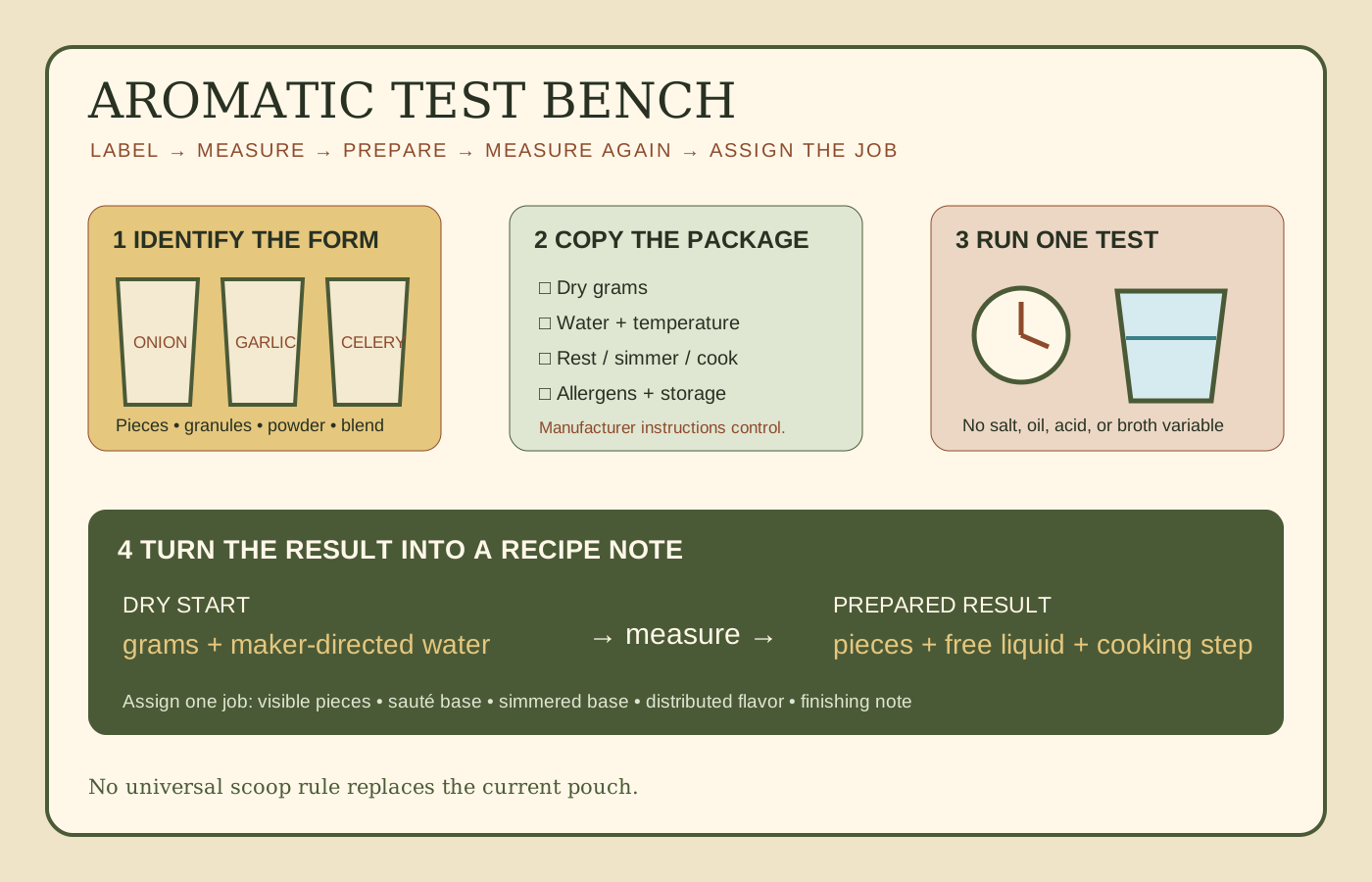
Aromatic ingredients are small in the bowl and large in the outcome. Onion pieces can provide sweetness and body; garlic can be a distinct bite or a background seasoning; celery can add texture, bitterness, and a familiar soup base. Drying format, cut size, fines, pre-cooking, and the final dish determine whether a pouch behaves like fresh dice, dried mince, or powder.
Search results and public cooking discussions offer sharply different conversion rules—one part dry to two parts water, one to three, or one to six; a spoonful for a clove; a third of the fresh volume. Those ratios often describe dehydrated products, restaurant-style dried onion, homemade food, or a particular brand. They reveal the real reader questions, but they do not create a transferable formula for freeze-dried onion, garlic, or celery.
The 2026 FDA Food Code expressly tells retail food establishments to follow manufacturer instructions for commercially packaged dehydrated food. At home, use the same label-first habit. Copy water, time, temperature, cooking, allergens, and storage from the exact package. A category-wide conversion cannot override those directions.
Separate format before you measure
Start with the identity statement and ingredient list. “Onion” may mean slices, dice, minced pieces, granules, powder, or a seasoned blend. “Garlic” can be pieces, chips, granules, or a fine culinary powder. “Celery” can mean stalk pieces, leaves, powder, or a product containing salt. These forms expose different surface area, carry different amounts in a cup, and distribute flavor differently.
| Copy this | Why it matters | Do not assume |
|---|---|---|
| Product identity | Confirms onion, garlic, celery, or a blend | A front-panel flavor name lists every ingredient |
| Form and cut | Pieces, flakes, granules, and powder hydrate and disperse differently | A cup of one form equals a cup of another |
| Ingredient list | Reveals salt, oil, starch, flavoring, broth, or another vegetable | “Savory” means plain |
| Allergen statement | Identifies major allergens in FDA-regulated packaged foods | An aromatic blend is allergen-free |
| Serving basis | Connects Nutrition Facts to grams or household measure | One serving equals one fresh onion or clove |
| Preparation and cooking | Defines water, time, temperature, direct-add use, and any required cooking | Softness proves ready-to-eat status |
| Storage and yield | Sets the unopened, opened, and prepared record | Dry shelf life continues after water is added |
The FDA explains that all nutrients on a Nutrition Facts label refer to its stated serving size. If a seasoned aromatic blend contributes sodium, multiply the labeled sodium by the servings used. A tiny dry volume can still represent several servings. Compare products only on the same basis, such as sodium per gram used or per measured cup of the finished dish.
Read allergen information on every new package. FDA's January 2025 guidance covers declaration of the nine major food-allergen sources on packaged foods under its jurisdiction. Plain vegetables may have a one-item ingredient list, while soup bases and seasoning blends can contain milk, wheat, soy, sesame, or other ingredients. Preserve the package information with the recipe note.
Freeze-dried and dehydrated are not interchangeable labels
Both products are dry, but the processes and finished structures differ. A ratio from a heat-dehydrated onion handbook should not be assigned to a freeze-dried pouch unless the actual manufacturer supports it. South Dakota State University Extension, for example, publishes a three-parts-water starting direction for dehydrated celery. That is useful for the product class it names; it is not permission to overwrite a freeze-dried celery package.
University of Arizona Cooperative Extension notes that freeze-dried produce can be covered with liquid and that actual time depends on the product and intended use. It also notes that produce can enter liquid-rich foods. Those are planning principles. The package still controls a commercial ingredient's specific preparation and cooking.
Run one portion without seasoning the evidence
Choose a single labeled serving or another small amount supported by the maker's instructions. The goal is to see what the documented method produces before salt, fat, acid, broth, or a second aromatic makes the result harder to interpret.
- Inspect the package. Record product, lot or date statement, storage condition, seal, and any damage. Do not use a wet, leaking, swollen, or otherwise compromised package.
- Mix only when directed. Fine pieces can settle. Follow any instruction to shake or stir before portioning; otherwise record the distribution you received.
- Weigh the dry portion. Grams travel more reliably than a loosely filled cup. Also record the labeled spoon or cup measure if one is provided.
- Copy the exact preparation. Record water amount and temperature, covered rest, stirring, draining, direct addition, simmering, and required final cooking.
- Start the clock. Do not add salt, oil, broth, acid, or another ingredient unless the directions call for it.
- Measure the result. Record prepared grams or cups, free liquid, largest-piece texture, aroma, and whether the product is ready for its required cooking step.
- Assign a kitchen job. Choose visible pieces, sauté base, simmered base, distributed flavor, powder, or finishing note.
Aromatic test card
Keep these twelve fields together
- Product and lot
- Ingredient list
- Form and cut
- Dry grams
- Labeled dry measure
- Water amount
- Water temperature
- Rest or simmer time
- Prepared grams or cups
- Free liquid
- Required cooking
- Best recipe job
Prepared yield is the useful conversion
A recipe usually asks for a function: one cup chopped onion to soften in fat, a minced garlic clove to bloom briefly, or diced celery to simmer until tender. Dry weight does not answer that request by itself. Prepare one measured portion, then measure the drained pieces or total mixture according to the package. Use that product-specific result as the starting conversion.
Water added is not prepared yield. Some water remains free, some adheres to the food, some is absorbed, and some may evaporate or be drained. If the maker states a prepared yield, keep it attached to that exact method. If the maker does not, describe your number as a kitchen test for that package and lot, never as a universal onion, garlic, or celery ratio.
Cup measures can hide cut distribution. Large onion pieces bridge and leave air space; garlic granules pack tightly; powder settles. A scale makes the first test repeatable, while prepared volume shows how the batch fits a recipe. Record both when possible.
Build a conversion card, not a permanent rule
Write: “10 grams of this onion product, prepared exactly as labeled on October 29, produced ⅓ cup drained pieces and 2 tablespoons free liquid.” That sentence contains product, amount, method, date, and outcome. “One spoon equals half an onion” does not.
Manufacturer formulations and cuts can change. Recheck the label when packaging, lot, serving basis, or instructions change. If a pouch and seller page disagree, use the current physical label and ask the manufacturer for clarification before relying on a prepared-yield claim.
Match the aromatic to the job
For soup, stew, beans, and braises
When the package permits direct addition, count the maker-directed water in the total pot liquid and give larger pieces their stated time. Add quick-hydrating herbs or powders later. The freeze-dried soup builder shows how to stage liquid, body, bulk, and concentrated seasoning without double-counting water.
If the package directs separate preparation, complete it first. Decide whether free liquid belongs in the pot based on the instructions and flavor test. A seasoned product's liquid may carry sodium and allergens; plain aromatic liquid can still change recipe volume.
For stuffing, casserole, and savory bread
These dishes often have limited free water, so unmeasured dry ingredients can pull moisture from the crumb or sauce. Prepare the aromatic separately when the package calls for it, measure the result, and subtract only documented retained liquid from the recipe when appropriate. Follow the complete dish's cooking directions and food-safety requirements, especially when it contains meat, eggs, dairy, or poultry juices.
Holiday public discussions frequently recommend scattering dry onion or celery into stuffing and “adding a splash.” That may work for one cut and recipe, but it is hard to repeat. A small prepared-yield test prevents a dry center or a wet pan without inventing a universal rule.
For a sauté base
A hydrated piece entering hot fat behaves differently from fresh onion releasing its own moisture. Drain only when directions allow, blot if needed for the intended recipe, and use moderate heat. Garlic powders and fine granules can scorch before larger onion or celery pieces soften. Cook forms separately until one measured batch establishes a workable sequence.
If a recipe depends on deep browning or caramelization, fresh onion may remain the better tool. Freeze-dried pieces can still contribute flavor, but the result should be judged as a different input rather than promised as an identical substitute.
For sauces, dips, and dressings
Powder or fine granules distribute readily but can thicken and intensify as they stand. Start from a labeled serving or manufacturer recipe, record the rest time, and evaluate after full hydration. Do not use a powder conversion for visible pieces, or a piece conversion for powder.
Cold dips and dressings may not include a kill step. Use products labeled and prepared for the intended use, safe drinking water, clean tools, and the package's cooking language. “Freeze-dried” alone is not a ready-to-eat claim.
For finishing
Some products are intended to soften in a hot finished dish; others require cooking. Confirm before sprinkling a dry aromatic at the table. A finishing product should still have a clear ingredient list, allergen statement, serving basis, and opened-storage direction.
Change one quality variable at a time
If the labeled method produces onion that is too firm, celery that is too soft, or garlic that dominates, keep the original test card. On the next batch, change one permitted variable: amount, recipe stage, drained versus retained liquid when the label allows, or cut after preparation. Do not erase a required cook step or replace safe handling to chase texture.
Flavor strength is not a safety indicator. A mild garlic product may still require cooking; an intense product may be ready for the use stated by its maker. Keep sensory notes separate from identity, cooking status, and storage.
Water starts a new handling clock
Freeze-drying removes moisture; it does not guarantee sterility or ready-to-eat status. FDA's 2026 Food Code added a clear manufacturer-instruction provision for commercially packaged dehydrated foods. The site's rehydration clock follows that transition from dry pouch to prepared food.
Use clean tools and water safe for drinking. Keep wet spoons, steam, and food residue out of the remaining dry pouch. Reseal and store the dry remainder exactly as the package directs. Do not extend an unopened shelf-life statement after opening, decanting, or repackaging.
Once the aromatics are hydrated or cooked into a perishable dish, follow the finished food's directions. USDA advises refrigerating leftovers within two hours, or one hour above 90°F, dividing large amounts into shallow containers, and using most refrigerated leftovers within three to four days. Reheat leftovers to 165°F; bring soups, sauces, and gravies to a rolling boil.
Use the current package for dietary decisions
Onion, garlic, and celery products can include salt, sugars, starches, oils, broth, dairy, wheat, soy, or sesame. Review the full label for each product and every new lot or formulation. Do not infer “low sodium,” “allergen-free,” or a special-diet fit from the vegetable name.
FDA says serving size is the basis for the nutrient values and is not a recommendation of how much to eat. When a whole pouch enters a recipe, multiply nutrients by the number of labeled servings used. For clinician-directed sodium, potassium, fluid, allergen, or digestive restrictions, use the household care plan and the exact package rather than a general aromatic guide.
What a useful future listing should prove
Freeze Dried Savory is still a preview catalog. Checkout, prices, inventory, availability, branded listings, reseller status, and supplier claims remain disabled until written authorization and accurate commercial terms are documented. A future aromatic listing should show ingredient identity, form and cut, dry net weight, Nutrition Facts basis, allergens, manufacturer preparation, cooking status, maker-stated prepared yield when available, storage before and after opening, lot traceability, and a support channel.
It should also separate verified manufacturer facts from kitchen observations. “The label states ¼ cup dry prepares ½ cup” is a manufacturer claim tied to the pouch. “Our test measured 47 grams after following that label” is a reproducible observation. Neither should become a claim about every freeze-dried onion, garlic, or celery product.
Questions from the prep bench
Do freeze-dried onions need rehydration before cooking?
Follow the exact package. Some may go directly into liquid-rich dishes; others specify separate preparation. Cut, processing, seasoning, and cooking status vary.
How much freeze-dried onion replaces one fresh onion?
Use a maker-stated prepared yield when available. Otherwise prepare and measure one labeled portion, then record the result for that product and lot. Dry cup volume is not a universal fresh-onion conversion.
Can freeze-dried garlic be used like garlic powder?
Pieces, granules, and powder perform different jobs. Confirm form and ingredients, follow preparation and cooking directions, and test a small measured portion.
Can I save the soaking liquid?
Follow the package. If retention is permitted, count it in recipe liquid and check ingredients, allergens, sodium, and cooking requirements. Discard any product with compromised packaging, odd odor, visible contamination, or uncertain storage rather than tasting it.
Sources
Reviewed October 29, 2026. Current product-specific manufacturer instructions remain controlling.
- U.S. Food and Drug Administration — Food Code 2026
- FDA — Summary of Changes in the 2026 Food Code
- FDA — How to Understand and Use the Nutrition Facts Label
- FDA — Food Allergen Labeling Guidance, Edition 5
- University of Arizona Cooperative Extension — Freeze-Drying Fruits and Vegetables
- South Dakota State University Extension — Celery: Preserve It
- USDA FSIS — How do I handle leftovers safely?
- USDA FSIS — What methods of reheating food are safe?