Pantry notebook 004 · October 20, 2026
How to rehydrate freeze-dried mushrooms
Treat the first bowl as a measured test. Keep the pouch directions intact, record dry and prepared amounts, separate texture from cooking status, and decide what job the mushrooms will do before they reach the pot.
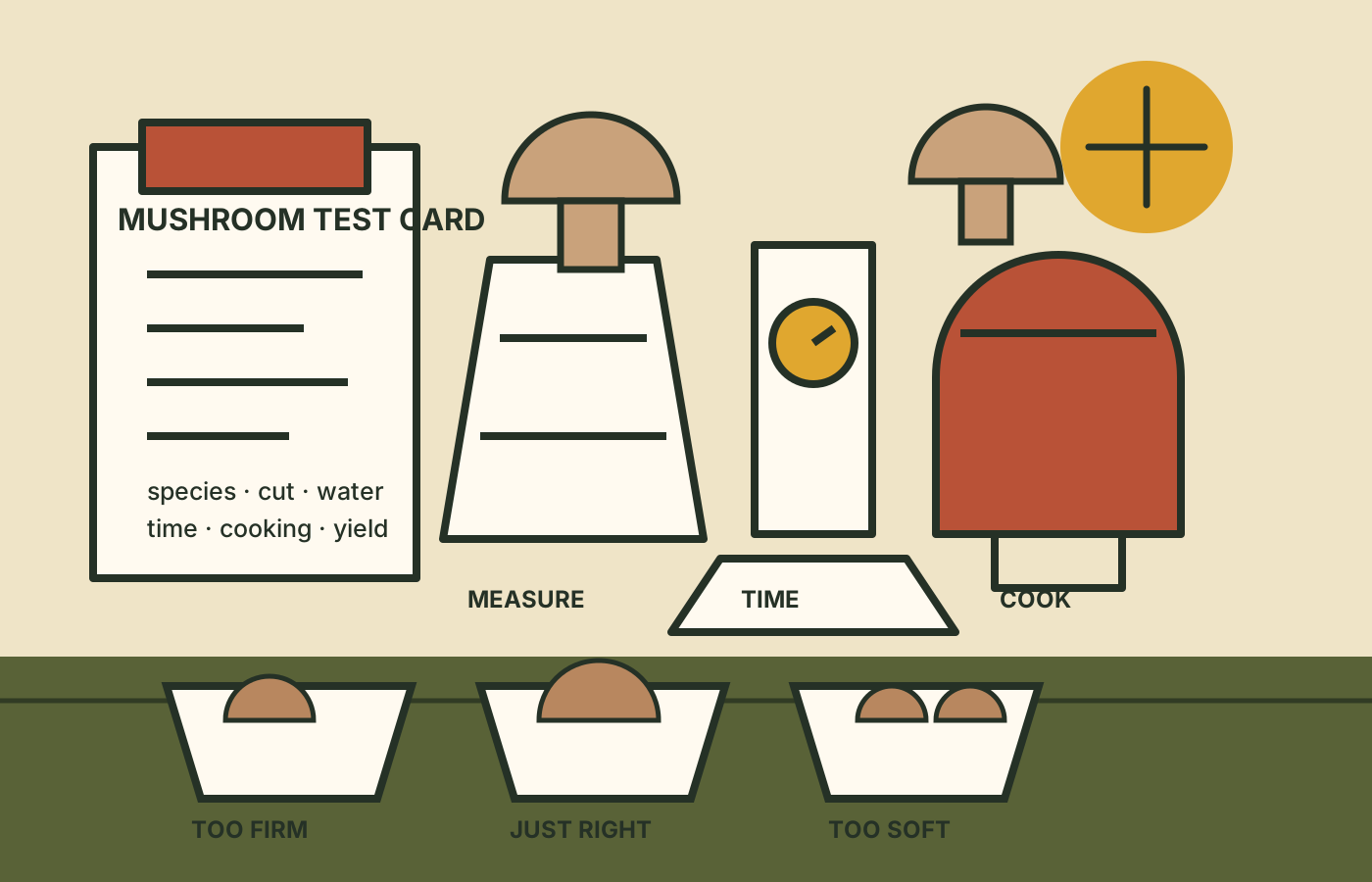
“How much water?” is only the first mushroom question. The answer changes with species, whole caps versus slices, powder and fines, plain versus seasoned ingredients, the maker's process, and whether the final dish needs distinct pieces, a smooth sauce, or a concentrated broth.
Recent public cooking discussions show the same cluster of practical problems: mushrooms stay chewy after soaking, the liquid looks too flavorful to discard, a recipe calls for fresh weight, and a jar contains several unfamiliar species with no obvious plan. Those conversations reveal useful search intent, but their crowd-sourced ratios and substitution numbers do not transfer safely from one product to another. A freeze-dried shiitake slice, an air-dried porcini piece, a mushroom powder, and a seasoned blend are four different inputs.
The reliable approach is small and repeatable: identify the exact product, follow its current instructions, measure what goes in and what comes out, and record how that prepared batch behaves in one recipe. This guide is for commercially packaged culinary mushrooms. It is not a wild-mushroom identification or foraging guide.
The 2026 FDA Food Code tells retail food establishments to prepare commercially packaged dehydrated food according to manufacturer instructions. The Food Code is a model for retail regulation, but its label-first principle is useful at home: a category-wide internet ratio should not replace directions for the exact pouch.
Name the mushroom before measuring water
“Mushroom mix” is not enough information for a useful pantry note. Begin with the product identity and ingredient list. Record each named species when the package provides it, the physical form, added salt or seasoning, serving basis, cooking language, and storage directions. If a seller page supplies more detail, match the product name and package size before using it.
| Copy this | What it changes | Red flag |
|---|---|---|
| Species or common name | Expected flavor, structure, and recipe role | A vague blend with no component identity |
| Form and cut | Whole, sliced, diced, crumbled, powder, or fines hydrate differently | A ratio borrowed from another cut |
| Ingredients and allergens | Plain mushrooms behave differently from broth, sauce, or seasoning blends | Assuming “savory” means unsalted or allergen-free |
| Water, time, and temperature | Defines the maker's starting preparation | Replacing stated directions with a generic soak |
| Cooking status | Shows whether hydration completes preparation or cooking still follows | Treating “soft” as proof of ready-to-eat status |
| Storage and prepared yield | Sets batch size and the clock after opening or hydration | Extending unopened shelf life to prepared food |
Confirm that “freeze-dried” is actually the format
Dried culinary mushrooms reach the shelf through different processes. A method printed for a dehydrated or sun-dried product should not be assigned to a freeze-dried product because both feel dry. Keep the package term in the test card. If the listing and pouch disagree, use the pouch and ask the manufacturer to clarify before building a repeatable recipe around it.
Cut distribution matters too. A bag can contain large cap pieces, thin slices, broken fragments, and powder. Measuring only by cup hides that variation. For a useful first test, gently mix the sealed or freshly opened product as directed, then weigh the dry portion when a kitchen scale is available. Photograph or note the cut range rather than claiming that every scoop is identical.
Run a one-portion mushroom test
Use one labeled portion or another small amount supported by the directions. The aim is not to invent a better formula on the first try. It is to learn what the documented method produces and preserve enough product for a controlled follow-up.
- Inspect and identify. Check the seal, lot, date or storage statement, and contents. Do not use a wet, leaking, swollen, or otherwise compromised package.
- Record the dry amount. Write both grams and any labeled household measure used. Note whether the portion contains mostly pieces, mostly powder, or a mixture.
- Copy the preparation. Record water amount and temperature, covered or uncovered rest, stirring, simmering, draining, and any required cooking step exactly as printed.
- Start the clock. Follow the direction without adding salt, acid, oil, broth concentrate, or another variable unless the package calls for it.
- Measure the result. Record prepared weight or volume, free liquid, largest-piece texture, aroma, and whether pieces stayed intact. Complete any required cooking before tasting.
- Assign a recipe job. Choose pieces, broth contribution, blended body, or seasoning. That decision guides the next test more clearly than a simple “liked it” score.
Mushroom test card
Keep these ten fields together
- Product and lot
- Named species
- Cut and fines
- Dry grams
- Water amount
- Water temperature
- Rest or cook time
- Prepared grams or cups
- Liquid retained or drained
- Best recipe job
Measure yield; do not reverse-engineer it from the water
Water added is not the same as prepared yield. Some remains free, some clings to the pieces, some is absorbed, and some may evaporate or be drained. When a manufacturer states a prepared yield, preserve that statement with its method. When it does not, label your measured result as a kitchen test for that product and lot rather than a universal conversion.
This distinction is especially useful when a recipe asks for fresh mushrooms by weight. Dry weight cannot simply replace fresh weight. Prepare a small batch, measure the result, and judge whether the recipe needs mushroom volume, browned surface, broth flavor, or blended body. A fresh mushroom that is sautéed until browned performs a different job from a hydrated piece stirred into soup.
Should the mushroom liquid stay?
There is no category-wide yes. Retaining the liquid can preserve mushroom flavor and recipe volume; draining may be required by the package or useful when the final dish needs a drier texture. The decision belongs after the label check and before seasoning.
| What you observe | Useful action | Why |
|---|---|---|
| Package says retain or add directly | Count the liquid in the recipe total | Avoids accidentally thinning soup, sauce, or grain |
| Package says drain | Drain as directed | Preserves the documented preparation |
| Liquid is clear but directions are silent | Ask the maker or run separate small recipe tests | Avoids turning preference into a product claim |
| Visible grit or debris | Do not pour it blindly into the dish; follow maker guidance | A fine strainer changes texture but does not answer identity or safety questions |
| Seasoned blend | Read sodium, allergens, and ingredients before retaining | The liquid may carry most of the seasoning |
| Odd odor, damaged package, or uncertain storage | Discard the product rather than taste-testing | Cooking and straining do not repair compromised storage |
If retained liquid enters risotto, noodles, gravy, or soup, subtract it from the recipe's other liquid and delay concentrated seasoning until the dish can be assessed. The freeze-dried soup builder gives a fuller method for staging water and sodium.
Match texture to the recipe job
A rehydrated mushroom does not need to imitate a fresh sautéed mushroom to be useful. Judge it by the job it can do well. Pieces can provide visible structure, smaller cuts can distribute flavor, retained liquid can support a broth, and documented culinary powder can season a sauce. Use only a powder labeled and prepared for food use; do not grind an unidentified blend or assume a powdered product is ready to eat.
For soup and stew
When the label permits direct addition, count the mushroom water in the pot and give larger pieces the stated time before quick-hydrating vegetables or herbs enter. If the package requires separate preparation, complete it first. Add concentrated broth near the end so mushroom liquid, sodium, and seasoning can be evaluated together.
For rice, noodles, and grains
The grain has its own liquid requirement, so keep the mushroom test separate until both methods are understood. In a follow-up batch, the documented mushroom liquid can replace part of the grain liquid only when the recipe and product directions support that use. Record the substitution. Do not add the full mushroom liquid on top of the full recipe liquid and expect the same texture.
For sauce, gravy, and blended body
If pieces remain too firm for the desired sauce after the complete labeled method, chopping the prepared pieces or blending a portion may fit the dish better than soaking indefinitely. Preserve any required cooking step. A culinary mushroom powder can thicken and intensify quickly, so start from its labeled serving or manufacturer recipe and record the amount rather than borrowing a spoonful rule from another product.
For a fresh-mushroom recipe
Ask what the fresh mushrooms contribute. If the recipe depends on browning, moisture release, or a meaty bite, a prepared freeze-dried product may change the result. If the role is broth, blended flavor, or distributed pieces, a measured test can be a practical starting point. Replace function first; scale the amount from measured prepared yield second.
If the complete labeled method produces pieces that are too firm or too soft for the intended dish, keep the original card intact. On the next batch, change one permitted variable—portion size, recipe stage, or cut after preparation—and record the result. Do not drop a required cooking step to chase texture.
Hydration and cooking are separate verbs
Freeze-drying removes water; it does not create a universal ready-to-eat claim. Follow the package's cooking language for the exact product. FDA's 2026 Food Code update reinforces manufacturer-directed preparation for commercially packaged dehydrated foods. The rehydration clock explains the full transition from dry storage through prepared leftovers.
Use clean tools and water that is safe to drink. Keep steam and wet spoons out of the dry pouch, then reseal and store the remainder according to the maker. Once mushrooms are hydrated or incorporated into a perishable dish, follow the product directions and safe time-and-temperature handling for the finished food. FDA consumer guidance says refrigerators should stay at 40°F or below and advises refrigerating foods that require refrigeration within two hours, shortened to one hour above 90°F.
For refrigerated leftovers, FoodSafety.gov lists 165°F for reheating and advises bringing soups, sauces, and gravies to a rolling boil. Large batches should be divided into shallow containers for prompt cooling. Product instructions or a household care plan may be more restrictive.
Allergens and claims still travel with the pouch
Plain mushrooms and a mushroom seasoning blend are different label-reading tasks. Check for dairy, wheat, soy, sesame, or other ingredients in broth and sauce blends. FDA's food-allergen guidance explains declaration requirements for major food allergens, but the current package remains the practical source for the actual product. “Mushroom” also does not support medical, immune, or therapeutic claims.
What a useful mushroom listing should show
Freeze Dried Savory remains a preview catalog. Prices, checkout, branded listings, inventory, availability, supplier claims, and reseller language stay disabled until authorization and accurate commercial terms are documented. A useful future mushroom listing should show the product and species identity, cut, ingredients, allergens, dry net weight, serving basis, manufacturer preparation, cooking status, maker-stated prepared yield when available, storage before and after opening, lot traceability, and customer-support channel.
It should also distinguish a seller's verified fact from a kitchen observation. “Prepared 20 grams according to this package and measured the finished batch” is reproducible. “All freeze-dried mushrooms replace fresh five-to-one” is not.
Sources
Reviewed October 20, 2026. Product-specific manufacturer instructions remain controlling.
- U.S. Food and Drug Administration — Food Code 2026
- U.S. Food and Drug Administration — Summary of Changes in the 2026 Food Code
- U.S. Food and Drug Administration — Serving Size on the Nutrition Facts Label
- U.S. Food and Drug Administration — Food Allergen Labeling Guidance, Edition 5
- U.S. Food and Drug Administration — Safe Food Handling
- FoodSafety.gov — Safe Minimum Internal Temperatures